From Incheon to Seoul
Wind, campfire and river sounds change with every scene, and the music follows the story.
In the early hours of June 25, 1950, the North Korean army crossed the 38th parallel and attacked. Seoul fell within three days, and the ROK and UN forces were driven back as far as the Nakdong River. The UN commander, Douglas MacArthur, planned a landing at Incheon, behind the enemy’s lines. There the tide rose and fell by nearly 10 meters and the channel was narrow, so ships could get in only during the few hours when the water was at its highest. Everyone was against it, but MacArthur pushed it through. The operation was named “Chromite,” and the date was September 15, the day of the highest tide.
Characters
1950, age seventy
Leader, 1st Platoon, 6th Company, 2nd Battalion
Age twenty-five
(fictional character)
Around midnight, September 15, 1950 — Palmido, off Incheon.
US Navy Lt. Clark and his Korean men slipped into the lighthouse held by the North Korean army.
The darkened lighthouse came alight.
Beyond its light, in the dark, some 260 ships lay waiting, holding their breath.
Aboard the warships and transports were some 70,000 troops.
At that same hour, in Seoul. Now in its third month under the North Korean army, the city held its breath, without a single light.
really coming?
they’ll come for sure.
Yeong-ho’s father had been separated from them as they fled on June 28, the day the Han River bridge went down, and there had been no word of him since.
Dawn, on the bridge of the command ship USS Mount McKinley. MacArthur, seventy years old, raised his binoculars.
We hit Wolmido first.
6:33 a.m. — Green Beach, Wolmido.
As naval guns and planes pounded the island, the landing craft cut through the water.
The 3rd Battalion, 5th Marines, went ashore on Wolmido.
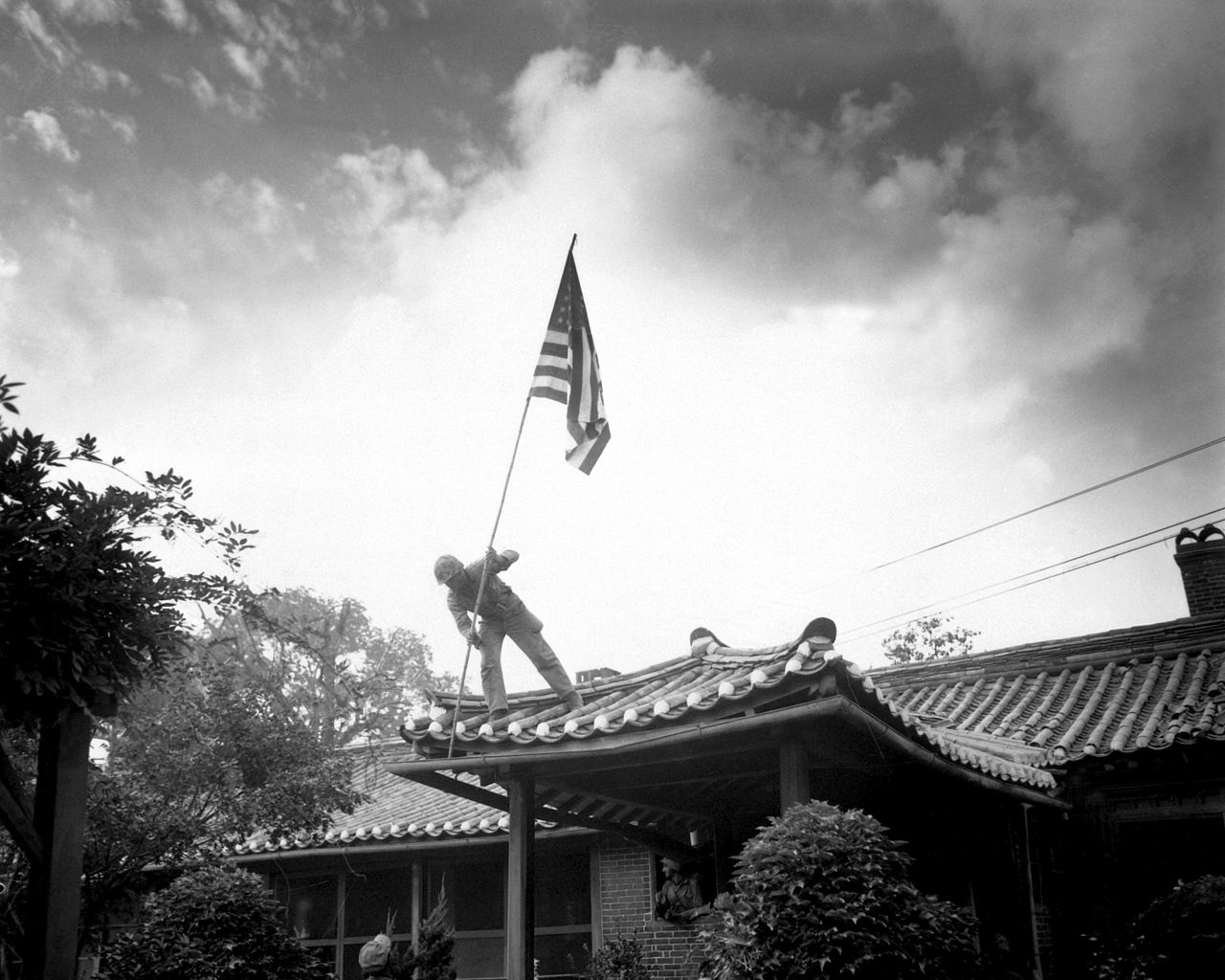
Some twenty minutes after the landing, the Stars and Stripes went up on the hilltop; in under two hours the whole island was taken.
Casualties were lighter than feared. But the real fight would come that evening.
When the morning tide went out, the sea off Incheon turned into endless mudflats.
Eleven hours until the next high tide.
The ships could only wait.
Meanwhile, the Marines on Wolmido held the island alone, and aircraft cut off the roads leading into Incheon.
At 5:30 p.m., riding the evening tide, the landing craft raced in again. To the north was Red Beach; to the south, Blue Beach.
Red Beach was barred by a stone seawall well over a man’s height.
From the landing craft, the Marines set up ladders and scrambled up the seawall.
Lt. Lopez led his platoon over the seawall.
Just as he was about to throw a grenade at an enemy position, a bullet cut him down.
The grenade, its pin already pulled, fell from his hand.
Lopez covered the grenade with his own body. He was twenty-five.
The sun went down, and under the flares the Marines took the hills one by one.
When night fell, eight tank landing ships loaded with ammunition and equipment ran themselves aground on the mudflats of Red Beach.
The ROK Marine Corps followed them ashore at Incheon and drove the enemy from every part of the city.
On September 17–18, the Marines retook Gimpo Airfield. On the 20th, they crossed the Han River at the Haengju ferry crossing in amphibious tractors.
The road to Seoul was blocked by the high hills of Yeonhui-dong.
For three days from September 22, on the Yeonhui Heights, US and ROK Marines fought the North Korean army over a single hill, taking it and losing it again and again.
The thunder of guns shook the sky over Seoul. Through a crack in the attic window, Yeong-ho watched the sky burning over Mapo.
it’s our side, right?
From September 25, fighting raged in the streets of Seoul.
The North Korean army had thrown up barricades of rice sacks and earth in every street.
With tanks in the lead, the Marines smashed through the barricades one by one.
Seoul burned.
At dawn on September 27, the platoon of 2nd Lt. Park Jeong-mo of the ROK Marine Corps climbed to the top of the Capitol building.
The North Korean flag came down —
The Taegukgi rose over the Capitol building.
On September 28, Seoul was retaken — after three months.
Long live Korea!
People who had been in hiding came out into the ruined streets and waved Taegukgi flags they had brought out from somewhere.
That day, all across Seoul, families that had been torn apart called out each other’s names.
Noon, September 29 — the Capitol building.
Beneath the shell-shattered roof, MacArthur and President Syngman Rhee stood face to face.
MacArthurIn behalf of the United Nations Command, I am happy to restore to you, Mr. President, the seat of your government.
As MacArthur recited the Lord’s Prayer, shards of glass from the broken ceiling came glittering down.
Syngman RheeWe admire you. We love you as the savior of our race.
Seoul became, once again, the capital of the Republic of Korea.
Just over two weeks from the Incheon Landing to the recapture of Seoul. In that time, thousands of American and ROK soldiers were wounded or killed, and in burning Seoul many civilians lost their lives.
But the war was not over.
In October, ROK and UN forces crossed the 38th parallel and drove north. All the way to the Yalu River — and from its far side, another army was crossing the river.