‹ Episodes
Ep. 10Kings Born from Eggs
EN
Episode 10

Kings Born from Eggs

The founding of Silla · 57 BCE
Scroll down ↓
🎧 It’s more vivid with sound.
Wind, campfire and river sounds change with every scene, and the music follows the story.
Previously

Biryu and Onjo, two sons of Jumong, the founder of Goguryeo, went south. Biryu, the elder, chose the sea and failed to realize his ambitions at Michuhol, while his younger brother Onjo founded “Sipje” by the Han River, renamed it “Baekje,” and ruled until 28 CE.

Characters

HogongA man who crossed the sea with a gourd at his waist.
He tells this story
Bak HyeokgeoseThe first king, who came
from an egg at Najeong
AryeongBorn of the chicken-dragon.
Hyeokgeose’s queen
Seok TalhaeA child who crossed
the sea in a chest
Kim Al-jiA child who came out of
a golden chest in the forest

By the dates of the Samguk Sagi, before Baekje, and even before Goguryeo.

In a basin ringed by mountains in the southeast of the Korean Peninsula,

a kingdom was hatching from an egg.

HogongI am Hogong. I came from Wa, across the sea.

HogongOur storyteller

HogongWhen I first crossed the sea, I wore a gourd at my waist. So people called me “Hogong,” from 瓠 (ho), the character for “gourd.”

HogongWhen I reached this land, people told me an old tale.

People who had come from old Joseon lived scattered among the mountain valleys, forming six villages.

A village chiefWe have no king above us, so the people do as they please.
Another village chiefLet’s find a man of virtue and make him our king!

The Egg at Najeong

The story of Bak Hyeokgeose, as told in the Samguk Sagi and the Samguk Yusa

Looking south from high ground, they saw a glow like a flash of lightning stretching down to the earth beside Najeong, a well at the foot of Mount Yang.

The six village chiefsWatching from the hill

A white horse was kneeling there, bowed low as if in homage.

When the people came near, the horse let out a long neigh and rose into the sky.

In its place lay a single large purple egg.

When they broke the egg open, a baby boy came out.

Village chiefIt’s a boy!

When they bathed him in the spring of Dongcheon, it is said, his body gave off light, and the birds and beasts danced.

Village chiefLet’s call him “Hyeokgeose,” so he’ll rule the world with bright light!

HogongThe night I heard that story, I fiddled with the gourd at my waist for a long time.

An egg shaped like a gourd…

HogongPeople here call a gourd (瓠) a “bak.” Because the great egg he came from was shaped like a gourd (瓠), they said, the child’s family name became “Bak” too.

In 57 BCE, the people of the six villages made the thirteen-year-old boy their king.

Bak HyeokgeoseThe first king, age thirteen
HyeokgeoseThis kingdom shall be called “Seonabeol”!

“Geoseogan” was the Jinhan word for a king, or for a person of high rank. Seonabeol, also called Seorabeol, would later become Silla.

In the first month of 53 BCE, it is said, a dragon appeared at Aryeong Well and gave birth to a baby girl from its side.

GrandmaOh my, her lips are just like a chicken’s beak…
AryeongBorn of a dragon

When she was bathed in the stream, the beak dropped right off. The child was named “Aryeong,” after the well.

Aryeong grew up to become queen. She was kind and virtuous, and a great help to the king.

In 41 BCE, the king and queen toured the six villages together, encouraging farming and the raising of silkworms.

FarmerThe Two Sages are here!

In 28 BCE, Lelang troops invaded the border villages.

Lelang soldierDoors left open at night, grain stacked out in the open…
Lelang commanderA sneak attack would make us no better than thieves. Let’s go back!

“They do not steal from one another. This is a land that follows the Way (道).” With those words, the Lelang troops withdrew.

In the west of the Korean Peninsula lay Mahan, a great power that held some fifty small states under it.

In the spring of 20 BCE,
I went to Mahan as an envoy.

King of MahanJinhan and Byeonhan are our vassals. Why do you send no tribute?
HogongSince the Two Sages arose, our storehouses are full and our people respect one another.
HogongI came as an envoy with all due courtesy. Why threaten me with soldiers?
King of MahanCut him down at once!

HogongOnly because his courtiers held him back did I make it home alive.

The following year, the King of Mahan died.

CourtierThat king once insulted our envoy. Strike now, while we can!
HyeokgeoseTo rejoice in another’s misfortune is not benevolent.

HogongThat king had tried to kill me. Yet our king sent an envoy instead, to offer condolences on his death.

The Chest from Across the Sea

The story of Seok Talhae, as told in the Samguk Sagi and the Samguk Yusa

Across the sea in Dapana, the queen gave birth to a large egg after a seven-year pregnancy.

King of DapanaA human giving birth to an egg? It’s an ill omen. Throw it away!
QueenMy little one, may you reach a good land…

The queen could not bear to throw it away. She wrapped the egg in silk, placed it in a chest, and set it adrift on the sea.

The chest, which even the people of Geumgwan would not take in, drifted on and reached Ajinpo in Jinhan.

GrandmaNow why is that magpie following it, crying like that?
AjinuiseonAn old woman of the shore
AjinuiseonOh my,
it’s a little boy!

Because a magpie (鵲) had followed the chest, he took the surname “Seok” (昔): the character for “magpie” (鵲) with its “bird” (鳥) part removed. And because he had come out by undoing the chest, he was named “Talhae” (脫解).

Talhae supported his mother by fishing. He never once showed a sign of laziness.

TalhaeA young man nine feet tall
MotherYou are no ordinary person. Study hard and make your mark.

Talhae applied himself to learning and mastered many things, even the principles of the land (geography).

It is said that Talhae climbed Mount Toham, built a stone mound, and spent seven days looking for a place to live.

TalhaeThat peak like a crescent moon… a land where one could live long.

HogongOf all places, it was my house.

HogongThat night, someone was secretly burying something beside my house.

TalhaeA whetstone… and charcoal. Done.

The next day, that boy insisted the house had belonged to his ancestors.

OfficialHave you any proof?
TalhaeMy family were blacksmiths from the start.
Dig up the ground and see!
WorkerA whetstone and charcoal!
HogongN-no…!

HogongA whetstone and charcoal really did come out of the ground. The house became that boy’s.

That house site later became “Wolseong,” the palace of Silla.

In 4 CE, Hyeokgeose died, and his son Namhae took the throne.

King Namhae married his eldest daughter to the wise Talhae,

gave him the high office of “Daebo,”
and entrusted him with the affairs of state.

In 24 CE, before he breathed his last, King Namhae called for his son Yuri and his son-in-law Talhae.

YuriSon of King NamhaeTalhaeSon-in-law of King Namhae
King NamhaeWhen I am gone…
of the two clans, Bak and Seok, let the elder take the throne.

When King Namhae died, each of the two men urged the throne on the other.

YuriLord Daebo, your virtue is great. Please take the throne.
TalhaeThe throne is a burden no ordinary man can bear.
TalhaeThey say a wise man has many teeth. Let’s each bite a rice cake.
CourtierLord Yuri has more tooth marks!

So Yuri became king, and the king was called “Isageum,” from “itgeum,” meaning tooth marks.

In 32 CE, Yuri Isageum renamed the six villages (the Six Bu),

and granted them six surnames: Yi, Choe, Son, Jeong, Bae and Seol.

That autumn, the women of the Six Bu split into two teams and competed at weaving for a whole month.

Woman of the losing sideHoeso, hoeso…

On the fifteenth day of the eighth month, the losing team laid out wine and food to treat the winners. This feast, “Gabae,” is seen as the root of Hangawi (Chuseok).

In 57 CE, Talhae, at sixty-two, finally became king.

The following year, Talhae made me Daebo.

The very boy
who had tricked me out of my house.

The Golden Chest in the Forest

The story of Kim Al-ji, as told in the Samguk Sagi and the Samguk Yusa

HogongOne spring night in 65 CE, a rooster crowed in Sirim. At daybreak, the king sent me to that forest.

HogongOn that branch… a golden chest!

HogongWhen the chest was opened, a little boy of striking looks sat up inside.

King TalhaeThe boy who crossed the sea
King TalhaeSurely Heaven has sent me a precious son!

The king took the child in and raised him. Because he was bright and clever, he was named “Al-ji,” and because he came from a golden chest, his surname was “Kim” (金).

Sirim, the forest where the white rooster had crowed, was renamed “Gyerim” (鷄林).

Kim Al-jiThe boy from the golden chest
朴Bak昔Seok金Kim
The egg looked like a gourd (瓠): Bak (朴)
“Magpie” (鵲) minus “bird” (鳥): Seok (昔)
He came from a golden chest (金櫃): Kim (金)

HogongI saw all three of them.

The king who came from an egg, the boy who took my house, and the child I found in the forest.

Village chiefLet’s find a man of virtue and make him our king!

HogongEvery one of them came from somewhere else. Just like me, who crossed the sea with a gourd at my waist.

According to the Samguk Yusa, even after Al-ji became crown prince, he yielded the throne to Pasa.

In 262, his descendant Michu became the first king of the Kim clan.

Silla, led by kings of three clans, Bak, Seok and Kim,
lasted nearly a thousand years.

End of Episode 10

History Notes

The scenes in this story are based on these records and sites.

  1. Two Histories, Two Slightly Different Stories

    In the Samguk Sagi, it is Sobeolgong, chief of Goheo village, who sees the kneeling horse; in the Samguk Yusa, the six village chiefs see a glow like lightning, a white horse and a purple egg. As for Aryeong, the Samguk Sagi records that she was born in 53 BCE, but the Samguk Yusa calls the dragon the “Gyeryong” (chicken-dragon) and places her birth on the very day Hyeokgeose appeared. The story of her lips like a chicken’s beak comes from the Samguk Yusa, and the story of the old woman who took her in from the Samguk Sagi. Because 57 BCE is a “gapja” year, the first year of the sixty-year cycle, some scholars think this year was chosen to make Silla look like the first of the kingdoms to be founded. This episode weaves together the stories from both books.

    Samguk Sagi · Samguk Yusa
  2. Najeong, GyeongjuNajeong, Gyeongju

    Najeong

    Najeong in Gyeongju, the site of the well where Hyeokgeose is said to have been born, lies in a pine grove. Excavations from 2002 to 2005 uncovered the site of an octagonal building about 8 m on each side. Many scholars believe it was where the royal house held rites in honor of the founder.

    Excavation of Najeong (2002–2005)
  3. Oreung Royal Tombs, GyeongjuOreung Royal Tombs, Gyeongju

    Oreung and the Tale of the Snake

    Oreung (the Five Tombs) in Gyeongju is said to hold the tombs of Hyeokgeose, Aryeong, and Kings Namhae, Yuri and Pasa. Hyeokgeose died in 4 CE, and the Samguk Yusa says that he rose into the sky, and that seven days later his body fell back to earth in five pieces. According to the legend, when people tried to gather the pieces and bury them together, a great snake stopped them, so they buried them in five separate places and called them “Oreung,” or “Sareung” (Snake Tombs). But round earthen mounds like these first appeared around the 4th century, so no one can tell whose tombs they really are.

    Samguk Yusa, “Wonders”
  4. The Riddle of Talhae

    The Samguk Yusa says the chest arrived in the reign of King Namhae, that the old woman who took in the child was Ajinuiseon, and that the child came from a land called “Yongseong.” The whetstone Talhae buried is a stone for sharpening blades, and charcoal is the fuel for heating iron; both are a blacksmith’s tools of the trade, so some scholars see Talhae’s group as people from across the sea who were skilled at working iron. The Samguk Sagi records that Talhae was sixty-two when he became king. Set against the year he crossed the sea as a baby, his age doesn’t add up: it is one of the riddles of the old records.

    Samguk Sagi · Samguk Yusa
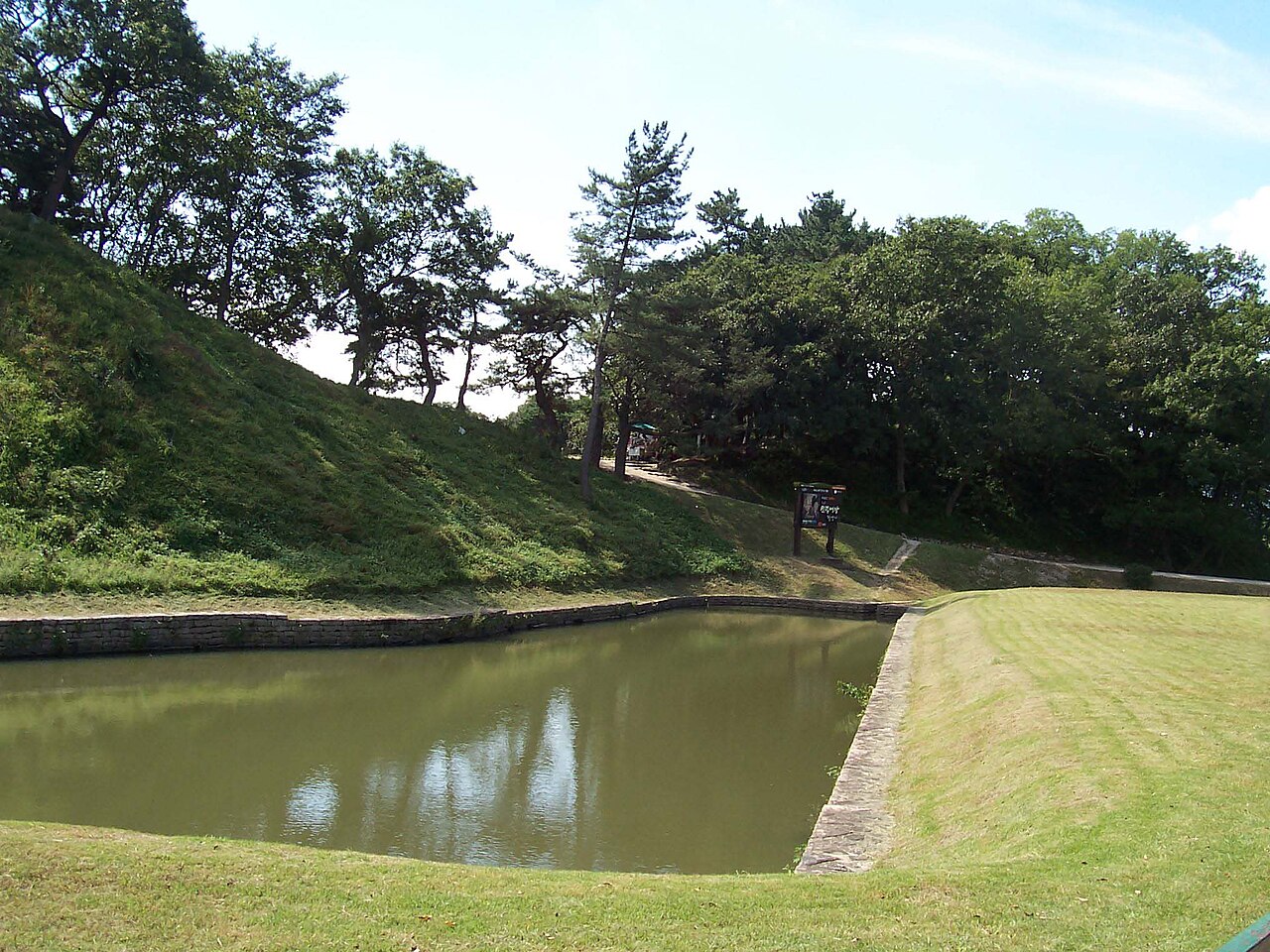
  5. Wolseong Fortress and its moat, GyeongjuWolseong Fortress and its moat, Gyeongju

    Wolseong, Site of Hogong’s House

    The Samguk Sagi says that Hogong’s family and surname are unknown and that he was originally a man of Wa, and that his house site, which Talhae took by trickery, later became Wolseong. Because it is shaped like a half moon, Wolseong is also called “Banwolseong” (Half-Moon Fortress). The Samguk Sagi records that in 101 King Pasa built a fortress here and moved his palace into it, but excavations suggest the walls were begun in the mid-4th century and finished in the early 5th century. Around the fortress, a water-filled ditch, a moat, was dug. If the records are right, Hogong was active for more than eighty years, from 20 BCE to 65 CE, which is another riddle of the old records.

    Samguk Sagi, Silla Annals · Excavation of Wolseong (2021)
  6. Jo Sok, “The Golden Chest” (1656)Jo Sok, “The Golden Chest” (1656)

    The Golden Chest, Preserved in a Painting

    This is “The Golden Chest” (Geumgwedo), painted in 1656 by the Joseon painter Jo Sok on the king’s orders to show the story of Kim Al-ji. A golden chest hangs from the branch of a big tree, and below it a white rooster looks up at the chest. The man approaching with an attendant is said to be Hogong, who found the chest. The Samguk Yusa dates the event to 60 CE, telling how Hogong, walking at night, saw a great light in the forest and purple clouds stretching from the sky down to the ground, and it explains that “Al-ji” means “little child” in the Korean language.

    Jo Sok, “The Golden Chest” · Samguk Yusa
  7. Gyerim forest in autumn, GyeongjuGyerim, Gyeongju

    Gyerim, and Bak, Seok and Kim

    Gyerim, the forest where Kim Al-ji was found, was at one time also used as a name for the country, and it still stands in Gyeongju between Cheomseongdae Observatory and Wolseong. Before he died, King Namhae is said to have declared, “Of the two clans, Bak and Seok, let the elder take the throne.” Later the Kim clan joined them, and the three clans are said to have taken the throne in order of age. Scholars see early Silla as “Saro,” a small state in the Gyeongju basin (one of the twelve states of Jinhan), and some read the stories of the three founders as traces of groups from different places joining forces to build a kingdom.

    Samguk Sagi, Silla Annals (Accession of Yuri Isageum) · Records of the Three Kingdoms, Book of Wei, “Account of the Eastern Peoples”

Key Words of This Episode

Next episode

Episode 11 · Turtle, O Turtle

The people gathered on Gujibong Peak sang: “Turtle, O turtle, show us your head.” Six eggs in a golden box, lowered from the sky on a purple cord, and Heo Hwang-ok, who crossed the sea. The beginning of Gaya awaits.

Photo credits

All illustrations in this webtoon are original. Character names and dialogue are imaginative reconstructions based on historical facts and research. Dates and interpretations follow mainstream scholarship; where scholars disagree, the History Notes say so.