‹ Episodes
Ep. 39Kim Yu-sin’s Sword
EN
Episode 39

Kim Yu-sin’s Sword

Kim Yu-sin · 595
Scroll down ↓
🎧 It’s more vivid with sound.
Wind, campfire and river sounds change with every scene, and the music follows the story.
Previously

In 648, Kim Chun-chu crossed the sea to Tang China and won a promise of troops from Emperor Taizong of Tang. On the voyage home, his follower On Gun-hae, sitting on deck in a tall hat and grand robes, was killed by a Goguryeo patrol that took him for Kim Chun-chu. Then, in 654, Kim Chun-chu took the throne. He was King Taejong Muyeol.

Characters

Kim Yu-sinA descendant of Gaya’s royal family.
A general of Silla
SeohyeonKim Yu-sin’s father.
Son of Kim Mu-ryeok
ManmyeongKim Yu-sin’s mother.
A daughter of Silla royalty
NanseungThe old man who appeared
in the stone cave on Jungak
MunhuiKim Yu-sin’s
youngest sister
Kim Chun-chuKim Yu-sin’s friend.
The future King Taejong Muyeol

In 648, when Kim Chun-chu went to Tang to ask for troops, Emperor Taizong is said to have asked him this.

Emperor Taizong of TangI have heard of your Yu-sin.
What sort of man is he?
Kim Chun-chuYu-sin has but a little
talent and wisdom.
Only with Your Majesty’s might
can we ease the threat
from our neighbors.

A Silla general whose name, it is said, had reached even the emperor of Tang.

What kind of man was Kim Yu-sin?

The story goes back half a century, to around 595, when he was born.

Kim Yu-sin’s family was originally Gaya royalty.

Kim Gu-haeGreat-grandfather · King of GeumgwanKim Mu-ryeokGrandfather · GeneralSeohyeonFather

In 532, Kim Gu-hae, the last king of Geumgwan (Geumgwan Gaya), surrendered to Silla. His youngest son, Kim Mu-ryeok, became a Silla general and crushed the Baekje army at Gwansan Fortress in 554.

Seohyeon, son of Kim Mu-ryeok, saw a young woman on the road and lost his heart to her.

ManmyeongSukheuljong’s daughter
Seohyeon…Who is she?

Manmyeong was a granddaughter of Ipjong Galmunwang, father of King Jinheung. Without any go-between, the two gave their hearts to each other.

When Seohyeon became governor of Manno County and tried to take Manmyeong with him, her father, Sukheuljong, who only then learned of it, flew into a rage.

SukheuljongManmyeong’s father
SukheuljongWithout my leave!
Lock her in
the outbuilding
and guard her!
ManmyeongFather…
The guardL-lightning!
SeohyeonHurry!
To Manno
County!

While the lightning that struck the outbuilding’s door sent the guards into confusion, Manmyeong slipped out through a hole in the wall and left with Seohyeon for Manno County.

Seohyeon’s dreamTwo stars…
are coming down to me!
Manmyeong’s dreamA child in golden armor,
riding on a cloud…!

The Samguk Sagi records that Seohyeon dreamed of two stars, Mars and Saturn, coming down to him, and Manmyeong dreamed of a child in golden armor riding a cloud into the house.

In 595, it is said, Manmyeong gave birth to a son twenty months after she conceived.

SeohyeonA good dream on
the gyeongjin night
brought us this child.
Let’s name him
“Yu-sin”!

Following the custom of not naming a child after a date (gyeongjin, 庚辰), he chose 庾 (yu), which looks like 庚, and 信 (sin), which sounds like 辰. The Samguk Yusa says the child had a pattern of seven stars on his back.

In 609, at fifteen, Kim Yu-sin became a hwarang.

Kim Yu-sinFifteen years old · Hwarang
Kim Yu-sinLet’s climb
higher!

People gladly followed him. His band was called the “Yonghwa Hyangdo.”

611. Goguryeo, Baekje and the Malgal invaded Silla’s land one after another. Seventeen-year-old Kim Yu-sin went alone into a stone cave on Jungak, the Central Peak.

Kim Yu-sinEnemy kingdoms, like jackals
and tigers, ravage our land.
Lowly as I am, O Heaven,
lend me your strength!

He purified himself and made a vow to Heaven.

On the fourth day, an old man in rough hemp clothes came to him.

Old manVenomous creatures
and wild beasts swarm here.
Why is a noble youth here alone?
Kim Yu-sinWho are you, sir?
May I ask your honored name?
NanseungI dwell nowhere; I go where fate leads.
My name is Nanseung.
Kim Yu-sinTeach me the secret arts
to defend my country!

The old man said nothing. Weeping, Kim Yu-sin begged him again and again, six or seven times.

NanseungYoung as you are, you have the will
to unite the three kingdoms.
How admirable.
Do not pass it on lightly.
If you use it unjustly,
disaster will fall on you instead.

Having spoken, the old man left. When he had gone about two li, Kim Yu-sin ran after him and looked, but—

The old man was gone; only a five-colored light blazed above the mountain.

The next year, 612, as the threat from neighboring kingdoms grew fiercer, eighteen-year-old Kim Yu-sin took a treasured sword and went alone into a deep valley on Mount Yeolbak.

Kim Yu-sinO Heaven,
once more I pray…

He burned incense and prayed to Heaven again and again, as he had on Jungak.

On the third night, rays of light from two stars, Heoseong and Gakseong, shone brightly down.

NanseungIf you use it unjustly,
disaster will fall
on you instead.

It is said the sword seemed to shake by itself.

Baekseok and the Three Guardian Spirits

An old tale from the Samguk Yusa

Among the followers of Kim Yu-sin, the gukseon (head hwarang), was a man named Baekseok. When Baekseok proposed that they secretly go and spy on the enemy kingdom, Kim Yu-sin set out with him by night.

Three womenWe are the spirits guarding
Narim, Hyeollye and Golhwa.
A man from the enemy kingdom
is luring you away!

Three women he met along the way led him into the woods and revealed themselves as gods.

Using some papers he had left behind as an excuse, Kim Yu-sin returned home, tied Baekseok up and questioned him.

BaekseokI am, in truth,
a man of Goguryeo…
Goguryeo sent me
to harm you.

Kim Yu-sin, it is said, punished Baekseok and offered a rite to the three gods with all kinds of food.

One morning a few years later, Kim Yu-sin’s sister Bohui began to tell of a dream. She had climbed the western mountain and relieved herself, and—

BohuiAnd the whole capital
was under water!
MunhuiSister, sell me
that dream!

Munhui bought her sister’s dream for a silk skirt.

A few days later, while playing kickball (chukguk) with his friend Kim Chun-chu in front of his house, Kim Yu-sin stepped on Kim Chun-chu’s robe and tore off its tie.

Kim Chun-chuOh, my tie…!
Kim Yu-sinOh dear, I stepped on it.
My house is close by;
come in and have it sewn.

The Samguk Yusa says Kim Yu-sin did it on purpose.

Kim Yu-sin told his sister Bohui to sew the tie back on for their guest, but Bohui did not come out.

BohuiHow could I go near a noble lord
over such a trifle…
MunhuiKim Yu-sin’s youngest sister
Kim Chun-chu…!

The youngest, Munhui, came out instead. Her makeup was light and her clothes were plain, but she was dazzlingly lovely.

According to the Samguk Yusa, when Munhui became pregnant, Kim Yu-sin made a show of spreading word that he would “burn his sister,” and on the day the queen climbed Namsan he made smoke rise from his yard.

Queen Seondeok…So this is your doing.
Go quickly and save her!

Kim Chun-chu, his face flushing deeply, galloped off to deliver the queen’s command, and the two were married openly and honorably.

A few years after that.

In autumn 629, Silla attacked Goguryeo’s Nangbi Fortress.

General Seohyeon and his son, thirty-five-year-old Kim Yu-sin,
were on that battlefield.

When the Goguryeo army came out of the fortress to strike back, the Silla army lost many men, and even its will to fight.

Silla soldierFall back!
Fall back!

Kim Yu-sin, commander of the Jungdang unit, went before his father and took off his helmet.

SeohyeonFather · General
Kim Yu-sinAll my life I have striven
for loyalty and filial duty.
I cannot be a coward in battle.
Lift the collar,
and the fur coat hangs straight;
pull the headrope,
and the net spreads wide.
I will be that collar
and that headrope!

Kim Yu-sin mounted his horse, drew his sword, leaped the trench and charged into the enemy ranks.

The Annals of the Samguk Sagi record that he went in three times and came out three times, each time cutting down a commander or seizing a banner.

Beating their drums, the Silla troops followed him in.

SeohyeonWell done,
my son…

With more than 5,000 cut down and 1,000 taken captive, the people of Nangbi Fortress were terrified, and all came out and surrendered.

In 642, Baekje brought down Silla’s Daeya Fortress.

The governor, Kim Pum-seok, and his wife Gotaso lost their lives. Gotaso was Kim Chun-chu’s daughter.

Their bones were buried
in a prison in Baekje.

In 648, Kim Yu-sin, military governor of Amnyangju, spent month after month drinking and enjoying music.

Kim Yu-sin…The people
are strong again.
TownsmanWe’ve rested so long we’ve strength to spare,
and the general just lazes about!

The Biographies in the Samguk Sagi date this to the time when Kim Chun-chu was away in Tang.

Kim Yu-sinThe people’s mood says
we can fight. Let us avenge
Daeya Fortress.
Queen JindeokQueen Seondeok’s successor
Queen JindeokIf a small kingdom provokes
a large one and falls into peril,
what then?
Winning or losing depends
not on size, but on
the hearts of the people.

Kim Yu-sin faced the Baekje army outside Daeya Fortress, then, feigning defeat, fell back as far as Okmun Valley.

Kim Yu-sinNow! Attack!

As the overconfident Baekje army rushed in, the hidden Silla troops struck from front and rear and captured eight Baekje commanders.

Kim Yu-sin’s messageThe bones of our governor
Pum-seok and his wife
lie buried in your prison.
Let us trade the bones of those two
for your eight commanders.
Jwapyeong ChungsangSilla skeletons
are of no use to us.
Let us send them back.

Baekje dug up the bones of Pum-seok and his wife and sent them back in a wooden chest.

Kim Yu-sinA lush forest is not diminished
when one leaf falls,
nor does a great mountain
grow when one speck
of dust settles on it.

As promised, Kim Yu-sin let the eight Baekje commanders go home alive.

Kim Chun-chu returned from Tang.

Kim Chun-chuThey say life and death
are up to Heaven, and here I am,
back alive to see you again.
Kim Yu-sinI have brought home the bones
of Lord Pum-seok and his lady.
It was Heaven’s help, not mine.

And so the bones of Pum-seok and his wife came home.

Kim Chun-chuGotaso…

Six years had passed since Daeya Fortress fell.

In 654, Queen Jindeok died.

Kim Yu-sin joined with the chief minister Alcheon to place Kim Chun-chu on the throne.

He was King Taejong Muyeol.

In the 1st month of 660, Kim Yu-sin became Sangdaedeung (chief minister). On the 26th day of the 5th month, King Muyeol and Kim Yu-sin led their army out of Seorabeol.

Kim Yu-sinSixty-six years old · Sangdaedeung
NanseungYoung as you are,
you have the will
to unite the three kingdoms.

The 130,000-strong army of Tang’s Su Dingfang was also about to cross the sea.

The sword said to have caught the starlight when he was eighteen.

The boy who once carried that sword, now a general of sixty-six, was heading for Baekje.

In the 7th month, at Hwangsanbeol, the Baekje general Gyebaek
was waiting with five thousand men sworn to die.

End of Episode 39

History Notes

The scenes in this story are based on these records and sites.

  1. Tomb attributed to King Guhyeong, SancheongTomb attributed to King Guhyeong, Sancheong · A stone tomb said to be that of Geumgwan’s last king

    A Descendant of Gaya Royalty

    The Biographies of the Samguk Sagi call Kim Yu-sin a twelfth-generation descendant of King Suro, founder of Geumgwan Gaya. His great-grandfather was Kim Gu-hae, the last king of Geumgwan, who surrendered to Silla in 532 (called “Guchung” in the Biographies and “King Guhyeong” in the “Record of Garak”); his grandfather was Kim Mu-ryeok, who made his name at the Battle of Gwansan Fortress in 554; and his father was Seohyeon. His mother, Manmyeong, was a granddaughter of Ipjong Galmunwang, father of King Jinheung. The Biographies tell how Manmyeong’s father, Sukheuljong, opposed the match and locked his daughter up, but she escaped when lightning struck. Some see this marriage between a descendant of Gaya royalty and the Silla royal house as the path by which a family of Gaya lineage entered the heart of Silla.

    Samguk Sagi, Biographies, Kim Yu-sin, Part 1 · Samguk Sagi, Silla Annals, King Beopheung and King Jinheung
  2. A Child Born after Twenty Months

    According to the Biographies, Seohyeon dreamed on a gyeongjin night that Mars and Saturn came down to him, and Manmyeong dreamed on a sinchuk night that a child in golden armor came into the house riding a cloud; she then conceived and gave birth twenty months later. This was in 595 (the 17th year of King Jinpyeong). Instead of “gyeongjin,” the day of his dream, Seohyeon chose “yu,” a character similar in shape, and “sin,” one similar in sound, giving as a further reason that a wise man of old had borne the same name. Manno County, where Kim Yu-sin was born, is today’s Jincheon in North Chungcheong Province, and the Biographies note that the mountain where his placenta was buried is called “Taeryeongsan.” The Samguk Yusa adds that he had a pattern of seven stars on his back.

    Samguk Sagi, Biographies, Kim Yu-sin, Part 1 · Samguk Yusa, “Wonders,” Kim Yu-sin
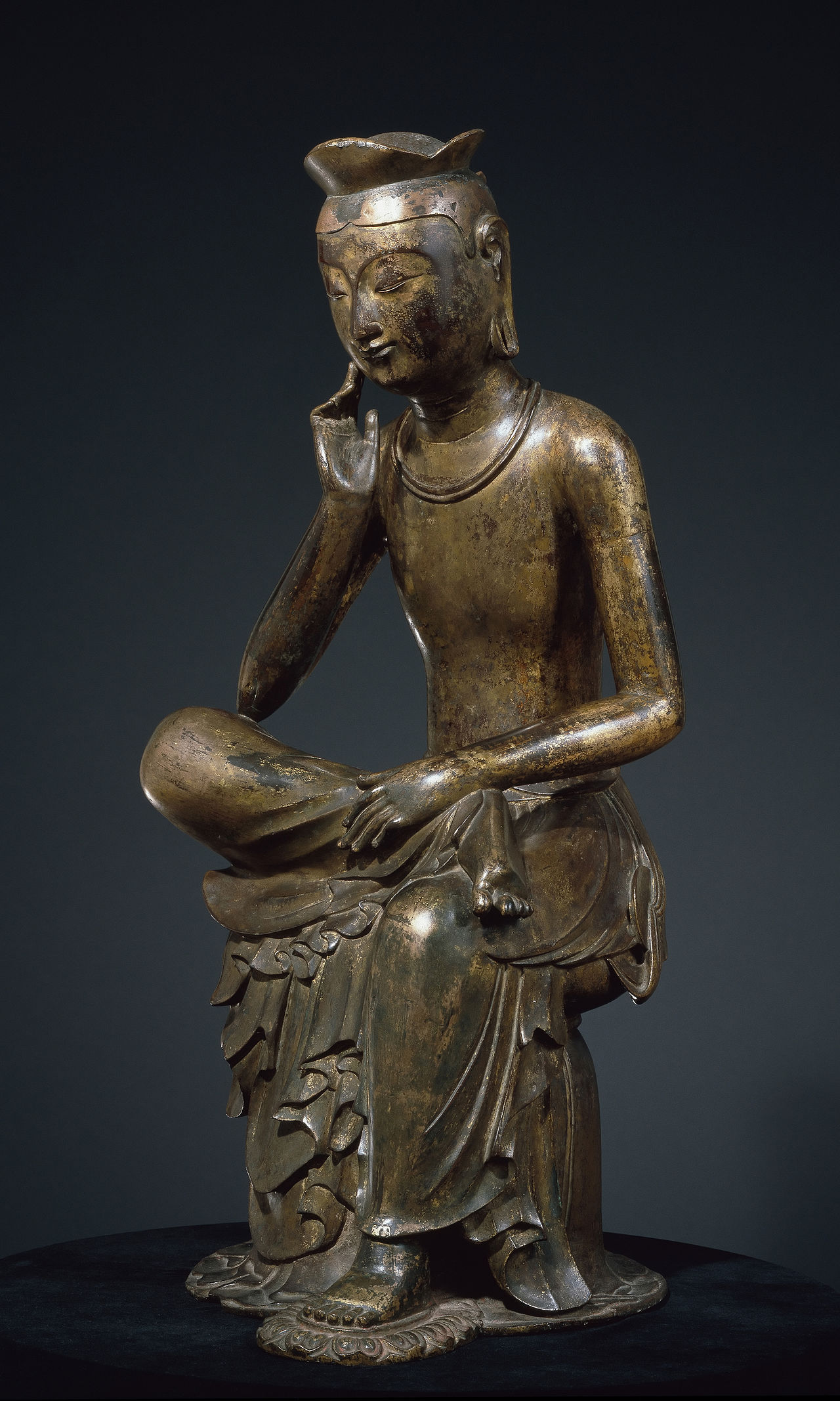
  3. Gilt-bronze Pensive Maitreya BodhisattvaGilt-bronze Pensive Maitreya Bodhisattva (National Treasure) · National Museum of Korea

    The Hwarang and the Yonghwa Hyangdo

    The Samguk Sagi records that when Kim Yu-sin became a hwarang at fifteen, people gladly followed him, and his band was called the “Yonghwa Hyangdo.” “Yonghwa” (Dragon Flower) comes from the belief that Maitreya, the Buddha of the future, will attain enlightenment beneath the Dragon Flower Tree, and the name is taken to show how the people of Silla linked the hwarang with Maitreya. The Samguk Yusa gives a slightly different age, saying he became “gukseon,” head of the hwarang, in 612, at eighteen. The well-known story that in his youth he broke off his ties with a woman named Cheongwan appears in neither book; it is a legend found in much later works.

    Samguk Sagi, Biographies, Kim Yu-sin, Part 1 · Samguk Yusa, “Wonders,” Kim Yu-sin
  4. Rock-carved Buddhas at Sinseonsa Temple, Danseoksan, GyeongjuRock-carved Buddhas at Sinseonsa Temple, Danseoksan, Gyeongju · Danseoksan, thought to be Jungak

    The Sword and the Stars — Jungak and Mount Yeolbak

    The old man Nanseung of Jungak (611) and the starlight that fell on the treasured sword on Mount Yeolbak (612) are legends recorded in the Biographies of the Samguk Sagi. Kim Bu-sik wrote Kim Yu-sin’s biography from the ten-volume Haengnok (Record of Deeds) by Kim Yu-sin’s great-great-grandson Kim Jang-cheong, cutting out much because it contained “many fabrications” and keeping only what was usable, so the biography preserves many stories handed down in the family. The rock cave at Sinseonsa Temple on Danseoksan in Gyeongju has long been known as the place where Kim Yu-sin trained, and since a survey in 1969 the view that it is the “stone cave on Jungak” has spread widely (it is a National Treasure, with Buddhas and an inscription of some 400 characters carved into the rock). However, the “Jungak” listed in the “Treatise on Rites” of the Samguk Sagi is Buak (Gongsan, today’s Palgongsan), so some identify the Jungak of Kim Yu-sin’s day differently. Where Mount Yeolbak was is unclear. Narim, Hyeollye and Golhwa, which appear in the Samguk Yusa story of Baekseok, were three mountains where Silla held great rites. The conversation of 648 in which Emperor Taizong of Tang asked about Kim Yu-sin is likewise found only in Kim Yu-sin’s biography.

    Samguk Sagi, Biographies, Kim Yu-sin, Part 1 · Samguk Sagi, Biographies, Kim Yu-sin, Part 3 · Samguk Yusa, “Wonders,” Kim Yu-sin · Samguk Sagi, Treatises, Rites
  5. Samguk YusaSamguk Yusa

    Munhui, Who Bought a Dream

    The story of Munhui, who bought her elder sister Bohui’s dream for a silk skirt and became Kim Chun-chu’s wife, appears in both the Samguk Sagi (under King Munmu) and the Samguk Yusa (under Lord Taejong Chunchu). The Samguk Sagi goes only as far as the dream on the summit of Mount Seohyeong, the ball game in which Kim Chun-chu’s robe tie was stepped on and torn off, and Kim Chun-chu asking for her hand after the lightly made-up Munhui sewed it back on. The ruse of raising smoke to catch the queen’s eye is found only in the Samguk Yusa, which places it in Queen Seondeok’s reign. Yet according to the Samguk Sagi, their second son, Kim In-mun, was born in 629, so the marriage probably took place before 632, when Queen Seondeok came to the throne. Munhui became Queen Munmyeong, and the Samguk Yusa says that since all six sons, including King Munmu (Beommin) and Kim In-mun, were born to her, “the omen of the bought dream came true.”

    Samguk Sagi, Silla Annals, King Munmu · Biographies, Kim In-mun · Samguk Yusa, “Wonders,” Lord Taejong Chunchu
  6. Nangbi Fortress, and Bones for Captives

    The Annals and the Biographies differ slightly on the Battle of Nangbi Fortress in 629. The Annals say that Kim Yu-sin, as a deputy general, went in and out three times, cutting down commanders or seizing banners; the Biographies say that he, then commander (dangju) of the Jungdang unit, leaped a trench and came back with the head of an enemy general. As for the site of Nangbi Fortress, one view places it at today’s Cheongju, as Joseon-era geographies did, while another, weighing where the border between the two kingdoms lay at the time, places it in northern Gyeonggi. The Battle of Okmun Valley in 648 also appears briefly in the Baekje Annals, dated to the 4th month, earlier than the winter of that year, when Kim Chun-chu left for Tang; the story of trading the bones of Pum-seok and his wife for eight Baekje commanders is found only in the Biographies. The Baekje Jwapyeong’s name appears as “Jungsang” in the main text of the Biographies and as “Chungsang” in a small note. The Biographies say only that the fighting took place outside Daeya Fortress and do not clearly state that the fortress was retaken then, but a record from 661 mentions a Silla governor stationed at Daeya.

    Samguk Sagi, Silla Annals, King Jinpyeong and King Taejong Muyeol · Baekje Annals, King Uija · Samguk Sagi, Biographies, Kim Yu-sin, Part 1 · Encyclopedia of Korean Culture
  7. Tomb of Kim Yu-sin, GyeongjuTomb of Kim Yu-sin, Gyeongju (Historic Site)

    Great King Heungmu, Kim Yu-sin’s Tomb, and What This Episode Imagines

    Kim Yu-sin died in 673 at the age of 79 and was buried at Geumsanwon. The Samguk Sagi says King Heungdeok (r. 826–836), and the Samguk Yusa says King Gyeongmyeong (r. 917–924), honored him as “Great King Heungmu” (the Samguk Yusa writes “Great King Heungho,” avoiding “mu,” the personal name of King Hyejong of Goryeo), making him a rare case of a subject raised to the rank of great king. The Tomb of Kim Yu-sin (a Historic Site) at the foot of Songhwasan in Chunghyo-dong, Gyeongju, has the twelve zodiac guardians, in civilian dress and holding weapons, carved on its encircling stones; some believe the tomb actually belongs to King Sinmu. In this episode, the looks and speech of Seohyeon, Manmyeong, Sukheuljong, Nanseung, Bohui and Munhui, the scenes in Chang’an, Amnyangju and the Baekje palace, and the scene of Kim Chun-chu at his daughter’s tomb are imagined.

    Samguk Sagi, Biographies, Kim Yu-sin, Part 3 · Samguk Yusa, “Wonders,” Kim Yu-sin · Encyclopedia of Korean Culture

Key Words of This Episode

Next episode

Episode 40 · Hwangsanbeol

Hwangsanbeol, 7th month of 660. With 5,000 men sworn to die, the Baekje general Gyebaek holds off Silla’s army of 50,000 four times. Before the unbreakable Baekje troops, sixteen-year-old hwarang Gwanchang rides out alone —

Photo credits

All illustrations in this webtoon are original. Character names and dialogue are imaginative reconstructions based on historical facts and research. Dates and interpretations follow mainstream scholarship; where scholars disagree, the History Notes say so.