‹ Episodes
Ep. 26To Sabi, and Then Gwansan Fortress
EN
Episode 26

To Sabi, and Then Gwansan Fortress

King Seong of Baekje · 523–554
Scroll down ↓
🎧 It’s more vivid with sound.
Wind, campfire and river sounds change with every scene, and the music follows the story.
Previously

On a stone tablet in the brick tomb uncovered at Songsan-ri, Gongju, in 1971 was carved the name “King Sama of Baekje,” that is, King Muryeong. Taking the throne in 501, King Muryeong put down Baek Ga’s revolt and drove back Goguryeo again and again, reviving a Baekje left reeling by the loss of Hanseong. When the king died in 523, his son Myeongnong took the throne and laid his father to rest in a tomb of lotus-patterned bricks.

Characters

King SeongKing of Baekje · His name was Myeongnong
King Muryeong’s son
ChangKing Seong’s eldest son
The future King Wideok
PrincessKing Seong’s daughter
Name not recorded
King MuryeongKing Seong’s father
(flashback)
Kim Mu-ryeokMilitary governor of Silla’s Sinju (軍主, the general in charge of a province)
Youngest son of the last king of Geumgwan
DodoKim Mu-ryeok’s aide
Gogan of Samnyeonsan County

The seventh month of 554. A mountain road in the dead of night.

The king of Baekje was hurrying through the dark with just fifty soldiers.

KingWe must get there before dawn.

Who was this king, and why had he taken to this road by night?

The story begins thirty-one years earlier,
in Ungjin, the Baekje capital.

In the fifth month of 523, King Muryeong died, and his son Myeongnong took the throne.

King Seong (Myeongnong)King Muryeong’s son · New king of Baekje
King SeongThis is the kingdom my father raised up again.
Now I will make it greater still.

The Samguk Sagi records that he was outstanding in wisdom and insight and decisive in handling affairs, so the people of the kingdom called him “King Seong,” the Sage King.

In the tenth month of 529, the seventh year of his reign, King Anjang of Goguryeo invaded at the head of his own army and took Hyeol Fortress on the northern frontier.

Jwapyeong Yeon Mo met them with 30,000 troops,
but he was defeated on the plain of Ogok, and over 2,000 men lost their lives.

Ungjin, the capital Baekje had hastily moved to after losing Hanseong in 475, was a narrow strip of land between mountains and a river.

CourtierThe mountains and river shield us. It’s ideal for defense.
King SeongBut it is too cramped.
There is not room enough for our people, or for our ships.

The king dreamed of a new capital: Sabi, a broad plain downstream along the Geum River.

King SeongMountains guard the north, and the river wraps around us.
Ships can sail down this river to the sea. To Liang, to Wa!

Sabi: a land where the Geum River curled around a low mountain, with a broad plain spreading out before it.

A fortress rose on Busosan, and below it, one by one, palaces, temples and broad avenues.

WorkerOne more layer! Pound it down hard!

In the spring of 538, Baekje at last moved its capital to Sabi.

ChildMom, is that the new capital?
MomYes, that’s it over there.
南扶餘
King SeongFrom this day, our kingdom shall be called “Nambuyeo”!

The Baekje royal house believed it had come from Buyeo. In the new capital, the king named the kingdom “Nambuyeo,” Southern Buyeo.

Sabi was a capital planned from the start. Its north and east sides were enclosed by a long earthen wall, the Naseong.

In 541, King Seong asked Liang, across the sea, to send him a scholar of the Book of Songs, commentaries on Buddhist scriptures such as the Nirvana Sutra, and craftsmen and painters.

King SeongWelcome, after your long voyage!
Liang scholarA king who treasures learning so!

Liang granted the request.

In the first month of 548, when Goguryeo, together with the Ye, attacked Baekje’s Doksan Fortress, King Seong asked his ally Silla for help. The Silla general Ju Jin led 3,000 armored troops, marching day and night, and crushed the Goguryeo army.

Baekje soldierThe Silla army is here!
Ju JinSilla general

In the first month of 550, Baekje took Goguryeo’s Dosal Fortress. In the third month, Goguryeo attacked Baekje’s Geumhyeon Fortress.

Then Silla, seizing the moment when both armies were exhausted,
took both fortresses for itself.

In 551, Baekje and Silla attacked Goguryeo together.

GoguryeoBaekjeSillaGayaYellow SeaEast SeaThe Han RiverGeum RiverJungnyeong PassSabiThe Baekje capitalSeorabeolThe Silla capitalHanseongLower Han, retaken by BaekjeUpper Han10 counties beyond Jungnyeong, taken by SillaBorders and locations are approximate;scholars disagree.

Baekje took its old lands on the lower Han, and Silla the ten counties of the upper Han beyond Jungnyeong Pass.

At last the Baekje army entered the land of Hanseong, its old capital on the Han River.

They had won back, after seventy-six years, the land lost in 475 when King Gaero lost his life.

King SeongFather… I have won back Hanseong.
King Muryeong…has become a strong nation once more.

King Seong’s father, King Muryeong, was the king who had once written to Liang that “Baekje has become a strong nation once more.”

In the seventh month of 553, Silla seized Baekje’s northeastern frontier — the land on the lower Han River — and set up “Sinju” there.

Kim Mu-ryeokMilitary governor of Sinju · Youngest son of the last king of Geumgwan
Kim Mu-ryeokFrom today, this land is Silla’s Sinju!

Urgent news reached the palace at Sabi. At the king’s side was his eldest son, Chang.

MessengerSilla… has seized the fortresses on the Han, Your Majesty!
ChangSilla has betrayed us!
Send out the army at once!
King Seong……

And so the alliance between the two kingdoms, which had lasted nearly 120 years, was broken.

In the tenth month of 553, King Seong’s daughter was married into Silla.

PrincessFather…
King Seong…Take good care of yourself.

It was three months after Silla had taken Baekje’s land on the Han. Why the king sent his daughter is not recorded anywhere.

Silla’s records say that in the tenth month of that year, King Jinheung took the Baekje king’s daughter as a “lesser queen” (sobi).

In the seventh month of 554, Baekje and Gaya attacked Silla’s Gwansan Fortress.

ChangAttack Gwansan Fortress!
Gaya soldierThe “Garyang” who fought beside Baekje

Silla’s military governor, Gakgan Udeok, and Ichan Tamji fought back, but the battle went badly for Silla.

Hearing the news, Kim Mu-ryeok, military governor of Sinju, rushed to Gwansan Fortress with the Sinju troops.

Kim Mu-ryeokRelieve Gwansan Fortress! Hurry!
DodoGogan of Samnyeonsan County · Kim Mu-ryeok’s aide
BaekjeSillaThe Han RiverGeum RiverUngjinSamnyeonsan County (Boeun)SabiThe Baekje capitalSinjuSilla province from 553 · Military governor Kim Mu-ryeokGwansan FortressToday’s Okcheon · Gucheon nearby (presumed)

Gwansan Fortress was a Silla fortress, east of Sabi, up the Geum River.

At first, the battle seemed to be tilting in Baekje’s favor.

And then came that night in the seventh month of 554.

Baekje generalYour Majesty, the stream ahead is Gucheon.
King SeongChang is waiting. Let us hurry.

The Samguk Sagi records that, intending to attack Silla, the king took only fifty foot soldiers and horsemen and reached Gucheon by night.

Across the stream, in the dark, Silla soldiers lay hidden.

Silla soldierTorches…
Dodo…Fifty or so. Wait.

The Silla ambush sprang.

Baekje’s record says only this of the king’s end.

The king was slain by soldiers
in the confusion of battle.

為亂兵所害薨 — Samguk Sagi, Baekje Annals, 32nd year of King Seong (554)

Day broke. Only riderless horses remained by the stream, wandering about.

King SeongWe must get there before dawn.

Silla’s records say that the Baekje king was killed by Dodo, Gogan of Samnyeonsan County and an aide to Kim Mu-ryeok.

Having lost its king, the Baekje army collapsed.

According to Silla’s records, four Baekje Jwapyeong and 29,600 soldiers lost their lives in this battle.

Outside the gate of Sabi, people waited for those who would not return.

ChildWhen’s Dad coming home?

Silla’s records add: “Not a single horse made it home.”

King Seong’s eldest son, Chang, took the throne. He is the king later known as “King Wideok.”

ChangFather…

How the princess who had married into Seorabeol heard the news of her father is not recorded anywhere.

ChangThis is the capital you built, Father.
King Seong…Now I will make it greater still.

Sabi, the capital King Seong built, remained the Baekje capital for more than 120 years after that.

The Han River, once won back, was lost again,
but the capital by the river remained.

End of Episode 26

History Notes

The scenes in this story are based on these records and sites.

  1. The Baengma River, BuyeoThe Baengma River (Geum River), winding around Buyeo

    Moving the Capital to Sabi, and “Nambuyeo”

    The Samguk Sagi records that in the spring of King Seong’s 16th year (538), the capital was moved to Sabi (also called Soburi) and the kingdom was renamed Nambuyeo. Ungjin, where the capital had been hastily moved in 475, was a narrow strip of land between mountains and a river, while Sabi was a broad plain linked to the sea by the Geum River waterway. Many scholars think King Seong planned the move from early in his reign, and since roof tiles stamped with “Datong” (527–529), a Liang reign title, have been found on Busosan, some think construction began around that time. Believing that it had come from Buyeo, the Baekje royal house took “Buyeo” as its surname.

    Samguk Sagi, Baekje Annals, King Seong · Samguk Yusa, “Nambuyeo, Former Baekje”
  2. Five-story Stone Pagoda at Jeongnimsa Temple Site, BuyeoFive-story Stone Pagoda at Jeongnimsa Temple Site, Buyeo (National Treasure)

    Sabi, a Planned City — Busosan Fortress, Naseong and Jeongnimsa Temple Site

    Sabi was a planned city, with a mountain fortress on Busosan, a low hill 106 meters above sea level, and the royal palace at its southern foot (the Gwanbuk-ri site). The capital’s north and east sides were enclosed by the Naseong, an earthen wall some 6.3 kilometers long, while the Geum River (Baengma River) curves around its west and south. Some scholars think the temple at the Jeongnimsa Temple Site, in the middle of the capital, was built after King Seong moved the capital, others in the 7th century, and many date the surviving five-story stone pagoda to around the 7th century. In 2015, these sites, together with sites in Gongju and Iksan, became a World Heritage Site as the “Baekje Historic Areas.”

    Encyclopedia of Korean Culture
  3. Mongchon Earthen Fortress, SeoulMongchon Earthen Fortress · A fortress of Hanseong-period Baekje (Songpa-gu, Seoul)

    The Han River in 551, Sinju in 553

    The biography of Geochilbu in the Samguk Sagi records that in 551, after the people of Baekje first broke “Pyongyang,” eight generals including Geochilbu and Gujin rode the momentum to take the ten counties lying beyond Jungnyeong and within Gohyeon. Many scholars see this “Pyongyang” not as the Goguryeo capital but as the Han River basin (today’s Seoul area). The Nihon Shoki (12th year of Emperor Kinmei) says that this year King Seong led his army in person, won the land of Hanseong, struck as far as Pyongyang and recovered six counties of old territory, but the Samguk Sagi says nothing specific about Baekje retaking Hanseong. Then in the seventh month of 553, Silla seized Baekje’s northeastern frontier, set up Sinju there and made Kim Mu-ryeok its military governor. Three months later, in the tenth month, King Seong’s daughter was married into Silla (the Silla Annals say King Jinheung took her as a “lesser queen”), but the records give no reason.

    Samguk Sagi, Biographies, Geochilbu · Baekje Annals · Silla Annals
  4. Samnyeonsan Fortress, BoeunSamnyeonsan Fortress, Boeun · A Silla mountain fortress in Samnyeonsan County, Dodo’s home district

    The Battle of Gwansan Fortress — Two Kingdoms’ Records

    The Baekje Annals say only that in the seventh month of 554, the king, intending to attack Silla, reached Gucheon by night with 50 foot soldiers and horsemen, met a Silla ambush and died. The Silla Annals record that when the Baekje king attacked Gwansan Fortress together with Garyang (Gaya), Gakgan Udeok and Ichan Tamji fought back but were pushed back; that Kim Mu-ryeok, military governor of Sinju, rushed to the scene and his aide Dodo, Gogan of Samnyeonsan County, killed the king; and that they cut down four Baekje Jwapyeong and 29,600 soldiers, so that “not a single horse made it home.” The biography of Kim Yu-sin in the same Samguk Sagi gives different numbers, saying that his grandfather Mu-ryeok captured the Baekje king and four generals and cut down more than 10,000 men. Gwansan Fortress is thought to have been in today’s Okcheon, North Chungcheong.

    Samguk Sagi, Baekje Annals, King Seong · Samguk Sagi, Silla Annals, King Jinheung · Samguk Sagi, Biographies, Kim Yu-sin
  5. The Story in the Nihon Shoki

    Japan’s history book, the Nihon Shoki (15th year of Emperor Kinmei), relates that when Prince Yeochang (Chang) went out to attack Silla and the fighting dragged on, King Seongmyeong (King Seong), worried about his exhausted son, set out to comfort him in person, but Silla troops cut off his road and he was killed by “Godo,” a slave who kept horses at Jwaji Village. Many scholars think Godo is the same man as Gogan Dodo of the Samguk Sagi; one reading is that the Silla records present him as a local magnate who earned merit, while the Nihon Shoki, which passed on the Baekje side of the story, lowered him to a slave. The book mixes in the Wa point of view, so it is hard to take at face value, but this episode borrows from it for the scenes and lines in which Chang leads the fighting and King Seong heads for his son’s camp.

    Nihon Shoki, Annals of Emperor Kinmei · Encyclopedia of Korean Culture
  6. King Seong and Buddhism in Wa

    The Nihon Shoki records that in the tenth month of 552, King Seong sent Dalsol Norisachigye to present the Wa court with a gilt-bronze statue of Shakyamuni Buddha, banners and canopies, and several volumes of sutras. Other Japanese records date this to 538 (the muo year), so many scholars take 538 as the year Buddhism reached Japan. King Seong was also the king who asked Liang in 541 for commentaries on sutras such as the Nirvana Sutra and for craftsmen and painters, so Baekje served as a bridge, passing what it had learned from China on across the sea to Wa.

    Nihon Shoki, Annals of Emperor Kinmei · Samguk Sagi, Baekje Annals, King Seong
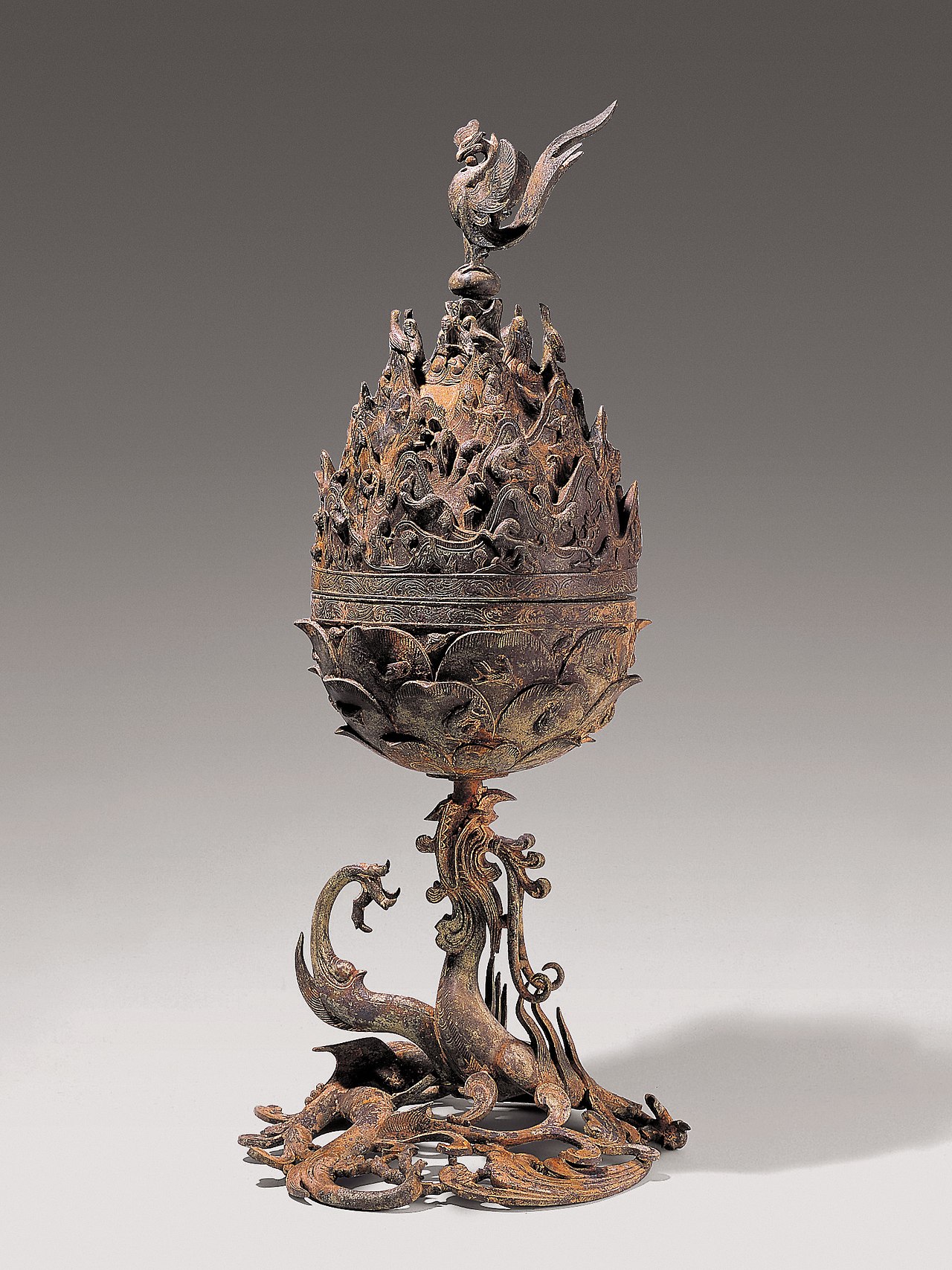
  7. Gilt-bronze Incense Burner of BaekjeGilt-bronze Incense Burner of Baekje (National Treasure) · Buyeo National Museum

    The Temple a Son Built — The Neungsan-ri Temple Site

    A stone sarira reliquary (National Treasure) found in 1995 at the temple site beside the royal tombs of Neungsan-ri, Buyeo, is inscribed: “In the 13th year of King Chang of Baekje, the jeonghae year (567), the princess, his younger sister, offered the sarira.” King Chang is none other than King Wideok, King Seong’s son, so the temple is thought to have been built to pray for the soul of his father, King Seong. In 1993, the Gilt-bronze Incense Burner of Baekje was found at this temple site. The courtiers, workers and children in this episode, the lines of King Seong, Chang and the princess, the great temple and wooden pagoda in the pictures, and the scene of the princess gazing west from Seorabeol are imagined.

    Stone sarira reliquary from the Neungsan-ri temple site, Buyeo · Buyeo National Museum

Key Words of This Episode

Next episode

Episode 27 · The Song of Seodong

Seodong, a poor boy who dug and sold yams, hands out yams to the children of Seorabeol in Silla and teaches them a little song. Where will that song, handed down in the Samguk Yusa, take the boy?

Photo credits

All illustrations in this webtoon are original. Character names and dialogue are imaginative reconstructions based on historical facts and research. Dates and interpretations follow mainstream scholarship; where scholars disagree, the History Notes say so.