‹ Episodes
Ep. 34The Waves of the Salsu
EN
Episode 34

The Waves of the Salsu

Goguryeo–Sui War · 612
Scroll down ↓
🎧 It’s more vivid with sound.
Wind, campfire and river sounds change with every scene, and the music follows the story.
Previously

Last time, we met Silla’s first queen, Queen Seondeok. Though she lost Daeya Fortress in 642 and was scorned by the Tang emperor, she raised the nine-story pagoda of Hwangnyongsa, and she died in 647 in the midst of Bidam’s rebellion. At her side stood two pillars of the kingdom, Kim Chun-chu and Kim Yu-sin.

Characters

Eulji MundeokA Goguryeo minister.
Full of stratagems, and a fine writer
King YeongyangKing of Goguryeo.
Stands up to Sui
Emperor Yang of SuiEmperor of Sui.
Attacks Goguryeo three times
Yu ZhongwenA Sui general.
Lets Eulji Mundeok slip away
Yuwen ShuA Sui general.
Drives all the way to Pyongyang
NaruA young soldier who follows
Eulji Mundeok · Imagined character

This time the story goes back to Goguryeo, about a generation before Queen Seondeok.

In 589, the Sui dynasty reunited China, which had long been split between north and south.

That great empire was looking east,
toward Goguryeo.

In the second month of 598, King Yeongyang of Goguryeo led more than 10,000 Malgal troops in an attack on the Sui lands of Liaoxi.

King YeongyangKing of Goguryeo
King YeongyangOn to Liaoxi!
Westward!

Wei Chong, the Sui area commander of Yingzhou, held them off and drove them back.

Emperor Wen of Sui flew into a rage and sent his son Yang Liang, Prince of Han, and others with 300,000 troops by land and sea to attack Goguryeo.

The summer rains cut the supply lines, and an epidemic broke out. Many of the ships that went by sea also sank in the storms.

Sui soldierThe wagon’s stuck!
Push!
They say the food…
is all gone.

In the ninth month, the Sui army went home. Eight or nine out of every ten had died.

King Yeongyang, afraid as well, sent an envoy to apologize, humbling himself as “the dung-and-dirt subject of Liaodong” (a subject as lowly as the rotten earth of Liaodong). Emperor Wen called off his troops and treated him as before.

Nine years later, Emperor Wen’s son, Emperor Yang,
set out for the northern steppe.

In 607, when Emperor Yang visited the tent of Qimin Khagan of the Göktürks, a Goguryeo envoy happened to be there.

Emperor Yang of SuiEmperor of SuiQimin KhaganKhagan (ruler) of the GöktürksGoguryeo envoy
Niu Hong, the emperor’s ministerTell your king
to come at once and pay homage.
If he does not,
we will lead Qimin
into your land!

Qimin did not dare hide the envoy and went with him before the emperor.

When the envoy delivered this message, King Yeongyang was afraid. Yet the king did not go to Sui.

King YeongyangSui…
will come for us.
Eulji MundeokThen Your Majesty must
prepare our defenses
in advance.
Eulji MundeokGoguryeo minister

The Samguk Sagi records that Eulji Mundeok was calm and resolute, full of stratagems, and could compose writings as well. It says his family background is unknown.

In 611, Emperor Yang proclaimed that he would attack Goguryeo and gathered troops from all over the empire at Zhuo Commandery (near today’s Beijing).

In the first month of 612, another imperial edict was issued.

The petty rabble of Goguryeo
is foolish and insolent.

高句麗小醜 迷昏不恭 — Samguk Sagi, 23rd year of King Yeongyang

The Samguk Sagi records that the troops gathered then numbered 1,133,800, called two million, and that those carrying their supplies were twice as many.

Emperor Yang of SuiAll of you, gather
at Pyongyang!

One army set out each day, 40 li apart, and it took 40 days for them all to leave. Their banners stretched for 960 li.

Liaoshui (Liao River)Amnoksu (Yalu)Salsu(today’s Cheongcheon)Paesu (Taedong)GoguryeoSuiBohai SeaYellow SeaLiaodong FortressPyongyang FortressEmperor Yang’s army← Zhuo CommanderyNine armies, 305,000Lai Hu’er’s navyRoutes/sites approximate;Salsu: likely Cheongcheon

Emperor Yang’s main army headed for Liaodong Fortress, the nine armies crossed the Yalu toward Pyongyang, and the navy made for Pyongyang by sea.

The Sui army reached the Liaoshui (today’s Liao River). The Goguryeo army held the river against them.

Goguryeo generalShoot!
Sui soldierThe bridge…
is too short!

The three pontoon bridges the Sui laid fell a little more than a man’s height short of the far bank.

Two days later the Sui troops had extended the bridges, and the Goguryeo army was badly defeated; Liaodong Fortress was surrounded. Emperor Yang had ordered, “In all matters, report to me first and wait.”

Goguryeo generalWe surrender!
We surrender!
Sui generalHurry, report it
to the emperor!

By the time the answer came back, the fortress had its defenses ready again. This happened two or three times.

Emperor Yang summoned his generals and gave them a furious dressing-down.

Emperor Yang of SuiYou trust in your rank and family,
and take me lightly?
I came to see what you were doing,
and to cut off your heads!

The generals all went white with fear.

Around that time, the Sui navy under Lai Hu’er crossed the sea and sailed into the Paesu (Taedong River).

Lai Hu’erCommander of the Sui navy
Deputy Commander Zhou FashangWe must wait until
the other armies arrive!
Lai Hu’erNo need
to wait!
On to Pyongyang!

His ships stretched for hundreds of li. He had just crushed a Goguryeo army 60 li from Pyongyang Fortress.

Lai Hu’er picked out tens of thousands of his best troops and pushed straight to the foot of Pyongyang Fortress.

GeonmuKing Yeongyang’s younger brother · Later King Yeongnyu
GeonmuDon’t let them set foot
on the soil of Pyongyang!

Chinese records tell that in this battle King Yeongyang’s younger brother Geonmu fought at the head of several hundred men sworn to die.

A Goguryeo general hid troops in an empty temple inside the outer walls, then went out to fight and fell back, pretending to be beaten.

Sui soldierWe’re inside!
Take everything!
Goguryeo generalNow!

When the ambush struck, Lai Hu’er was badly beaten and barely escaped with his life. Only a few thousand of his men made it back alive.

Meanwhile, the nine armies of Yuwen Shu, Yu Zhongwen and others, 305,000 strong when they crossed the Liao River, gathered west of the Yalu.

Yu ZhongwenSui general · Grand General of the Right GuardYuwen ShuSui general · Grand General of the Left Guard
Yuwen ShuAnyone who throws away rice or millet
will be beheaded!

Each soldier carried 100 days’ rations, plus armor and spears, cloth and tents. Each man’s load came to more than 3 seok.

Unable to bear their loads, the soldiers secretly dug pits inside their tents and buried the rice.

By the time they were halfway there, their food was already running out.

Sui soldierWe can’t go on
carrying all this…
Shh! If we’re caught,
it’s our heads.

King Yeongyang sent Eulji Mundeok to the Sui camp to offer a false surrender.

King YeongyangPretend to surrender,
and find out how things
really stand with them.
Eulji MundeokI will go and return.
NaruEulji Mundeok’s soldier · Imagined character

In truth, it was a mission to spy out the enemy’s condition.

Eulji Mundeok crossed the Yalu and walked into the Sui camp.

NaruGeneral,
there are spears everywhere…
Eulji MundeokKeep your head up.
And take a good look.

Yu Zhongwen had already received a secret order from the emperor: “If the king or Eulji Mundeok comes, be sure to take him captive.”

Yu ZhongwenSeize
that man!
Liu ShilongYou must not! He came
here to surrender!
Liu ShilongSui pacification officer

When Liu Shilong insisted on stopping him, Yu Zhongwen sent Eulji Mundeok back.

Yu Zhongwen soon regretted it and sent a man to call Eulji Mundeok back.

Sui manThere is more to discuss.
Come back!
NaruGeneral…
they’re calling you.
Eulji MundeokDon’t look back.

Without looking back, Eulji Mundeok crossed the Yalu and returned.

Having let Eulji Mundeok get away, the two generals were uneasy.

Yuwen ShuOur food is gone.
We must turn back.
Yu ZhongwenWith 100,000 men we can’t
crush one petty foe—
how can we face
the emperor?

Since the emperor had told them to follow Yu Zhongwen’s command, Yuwen Shu had no choice but to cross the Yalu and go after Eulji Mundeok.

Seeing that the Sui troops were starving, Eulji Mundeok fled in every fight to wear them out.

NaruGeneral, are we
falling back again?
Eulji MundeokThey are starving.
Let them win.

In a single day, Yuwen Shu’s army fought seven times and won all seven.

Elated by victory after victory, the Sui army crossed the Salsu and camped on a mountain 30 li from Pyongyang Fortress.

Eulji Mundeok composed a poem and sent it to Yu Zhongwen.

神策究天文妙算窮地理戰勝功旣高知足願云止
NaruOn the battlefield…
you’re writing a poem?
Eulji MundeokIt is a poem of praise.

The poem Eulji Mundeok sent to Yu Zhongwen

Your wondrous plans have fathomed the heavens,
your subtle reckoning has mastered the earth.
Your victories have already won great merit;
know when you have enough, and stop, I pray.

神策究天文 妙算窮地理 戰勝功旣高 知足願云止 — Samguk Sagi, Biographies, Eulji Mundeok

Yu Zhongwen“Know when you have enough…
and stop”?

Yu Zhongwen sent back a reply admonishing Eulji Mundeok.

Eulji Mundeok again sent an envoy with a false surrender.

Goguryeo envoyIf you withdraw your army,
we will bring our king
to pay homage to the emperor.
Yuwen ShuThe men are worn out…
and that fortress is forbidding.

Yuwen Shu used these words as an excuse to turn his army back.

The Sui army formed a square and withdrew.

Sui generalHold
the formation!

With the Goguryeo army striking from all sides, they had to fight as they retreated.

In the seventh month of 612, the retreating Sui army reached the Salsu.

When the army was halfway across the river—

Eulji MundeokNow!
Attack!

The Goguryeo army fell on the Sui rear guard from behind.

The Sui general Xin Shixiong fell fighting. The armies collapsed all at once, and nothing could stop the rout.

Sui soldierRun!

The survivors fled for a day and a night and reached the Yalu. It was a journey of 450 li.

When they first crossed the Liao River, the nine armies numbered 305,000.

Those who made it back to Liaodong Fortress
numbered 2,700.

Samguk Sagi, 23rd year of King Yeongyang

Eulji MundeokKnow when you have enough,
and stop, I pray.
Eulji MundeokIf only they had known
when to stop…
NaruGeneral…
we won.

The waves of the Salsu grew calm once more.

In a fury, Emperor Yang had Yuwen Shu and the others bound in iron chains, then withdrew his army and went home.

All that Sui gained in this war was Muryeora, a small Goguryeo fort west of the Liao River.

Emperor Yang of Sui305,000…
down to 2,700?!

In 613, Emperor Yang invaded again and attacked Liaodong Fortress day and night for more than 20 days. But then Yang Xuangan rose in rebellion inside Sui.

Goguryeo soldier…It’s too
quiet.
Goguryeo generalIt’s a trick.
Don’t go out!

Emperor Yang had secretly turned his army back in the middle of the night. Suspecting a trick, the Goguryeo army waited two days before giving chase.

In 614, Emperor Yang raised an army for the third time. But Sui was already in turmoil everywhere, and the troops he summoned could not arrive in time.

When Lai Hu’er, coming by sea, defeated the Goguryeo army at Bisa Fortress and was about to head for Pyongyang, King Yeongyang sent an envoy to offer surrender and handed over Husi Zheng, who had fled to Goguryeo from Sui.

Emperor Yang was pleased and withdrew his army.

Back in his capital, Emperor Yang once again ordered King Yeongyang to come and pay homage.

Emperor Yang of SuiCome at once and pay homage.
King Yeongyang…I will not go.

King Yeongyang never went.

After that, rebellions broke out across Sui without end.

In 618, Emperor Yang was killed by his own officials at Jiangdu (today’s Yangzhou), and the Sui dynasty fell.

That same autumn, King Yeongyang of Goguryeo also died. The throne passed to his half-brother Geonmu.

How Eulji Mundeok lived after that is not recorded. In the Samguk Sagi, Kim Bu-sik wrote:

That the great Sui army was all but wiped out
was the work of one man, Eulji Mundeok.

滅其軍幾盡者 文德一人之力也 — Samguk Sagi, Biographies, Eulji Mundeok

End of Episode 34

History Notes

The scenes in this story are based on these records and sites.

  1. Sui ceramic warrior figurinesSui ceramic warrior figurines · Henan Museum, China

    The Figure of 1,133,800

    Following Chinese records, the Samguk Sagi states that the Sui army of 612 numbered 1,133,800, was called two million, and that those carrying its supplies were twice as many. It also says that one army set out each day for 40 days and that the banners stretched for 960 li. Counting the supply carriers, that would come to more than three million, so some think the troops who actually fought were fewer than this, while others accept the record as it stands. Either way, it was an expedition of rare size: the Samguk Sagi remarks that “in recent ages there had never been so grand a campaign.”

    Samguk Sagi, Goguryeo Annals, King Yeongyang
  2. Liaodong Fortress

    Liaodong Fortress stood on the site of Xiangping, a Han-dynasty fortress, in the area of today’s Liaoyang in Liaoning Province, China. In 612 it held out for months, buying time by offering to surrender whenever it was in danger. In 613, the Sui army made more than a million cloth sacks filled with earth to pile up a road as high as the walls, and even built eight-wheeled siege towers taller than the fortress; just as the all-out assault was about to begin, Yang Xuangan’s rebellion broke out inside Sui, and the crisis passed. A mural in the Goguryeo tomb known as Yodongseongchong (Liaodong Fortress Tomb) in Suncheon, South Pyongan Province, shows this fortress together with the characters “遼東城.” Liaodong Fortress would fall to the Tang army in 645.

    Samguk Sagi, Goguryeo Annals, King Yeongyang
  3. Taedong Gate, PyongyangTaedong Gate, Pyongyang · A gate of Pyongyang Fortress on the Taedong River (rebuilt in 1635)

    The Navy at Pyongyang, and Geonmu

    The Sui general Lai Hu’er led the fleets of the Yangtze and Huai river region across the sea and into the Paesu (Taedong River). The Samguk Sagi records that he came right up to the foot of Pyongyang Fortress with tens of thousands of elite troops but was badly defeated by an ambush hidden in an empty temple inside the outer walls, and only a few thousand made it back alive. The name of the general who led the ambush is not recorded. Chinese records also tell of this battle. The biography of Lai Hu’er in the Book of Sui says that when the Sui troops scattered to loot inside the walls, the Goguryeo king’s younger brother Geonmu (建武) gathered 500 men sworn to die and attacked, and Lai Hu’er pulled back; the History of the Northern Dynasties says that the king’s younger brother “Geon” (建) came out to fight with several hundred men sworn to die and was beheaded. Neither story appears in the Samguk Sagi. Because the names match, this man is usually identified with King Yeongnyu (Episode 35), who succeeded his elder brother in 618; if so, this passage in the History of the Northern Dynasties is not accurate.

    Samguk Sagi, Goguryeo Annals, King Yeongyang · Book of Sui · History of the Northern Dynasties
  4. An early edition of the Samguk SagiAn early edition of the Samguk Sagi

    Eulji Mundeok’s Poem

    The poem Eulji Mundeok sent to Yu Zhongwen has come down to us in the biography of Eulji Mundeok in the Samguk Sagi. A short poem of four lines of five characters each, it is counted among the oldest classical Chinese poems preserved in Korean history. On the surface it lavishly praises the enemy general’s cunning, but the last line, “know when you have enough, and stop, I pray,” is read as a sneer telling him it is time to withdraw. Yi Gyu-bo of Goryeo praised the poem’s phrasing as striking and archaic, full of vigorous spirit.

    Samguk Sagi, Biographies, Eulji Mundeok · Encyclopedia of Korean Culture
  5. Where Was the Salsu?

    Salsu is the Goguryeo-era name of a river generally identified with today’s Cheongcheon River in North Pyongan Province. According to the Samguk Sagi, the nine Sui armies crossed the Salsu and came within 30 li of Pyongyang Fortress, then were attacked from behind on the way back when they were halfway across the Salsu. The survivors fled 450 li in a day and a night to reach the Yalu, and of the 305,000 who had crossed the Liao River, only 2,700 made it back to Liaodong Fortress. This battle is called the Great Victory at Salsu (Salsu Daecheop).

    Samguk Sagi, Goguryeo Annals, King Yeongyang · Encyclopedia of Korean Culture
  6. Who Was Eulji Mundeok?

    The biography in the Samguk Sagi says that Eulji Mundeok’s family background is unknown. The late-Joseon Haedong Myeongjang-jeon says he was from Seokdasan in Pyongyang, but it was written much later and is not reliable; some scholars take “Eulji” to be the same as “Yuchi” (尉遲), a surname of the Xianbei people, and think he came from a naturalized family. Kim Bu-sik said the near-annihilation of the great Sui army was “the work of one man, Eulji Mundeok,” and in 1908 Sin Chae-ho published the biography Eulji Mundeok, which made him widely known as a hero who defended the nation. In this episode, the young soldier Naru who follows him is an imagined character, and the scene with Eulji Mundeok in the palace in 607, Geonmu galloping out, Eulji Mundeok on the hill above the Salsu, the words the characters exchange, and the look of the tents and the ferryboat were created on the basis of the records.

    Samguk Sagi, Biographies, Eulji Mundeok · Encyclopedia of Korean Culture
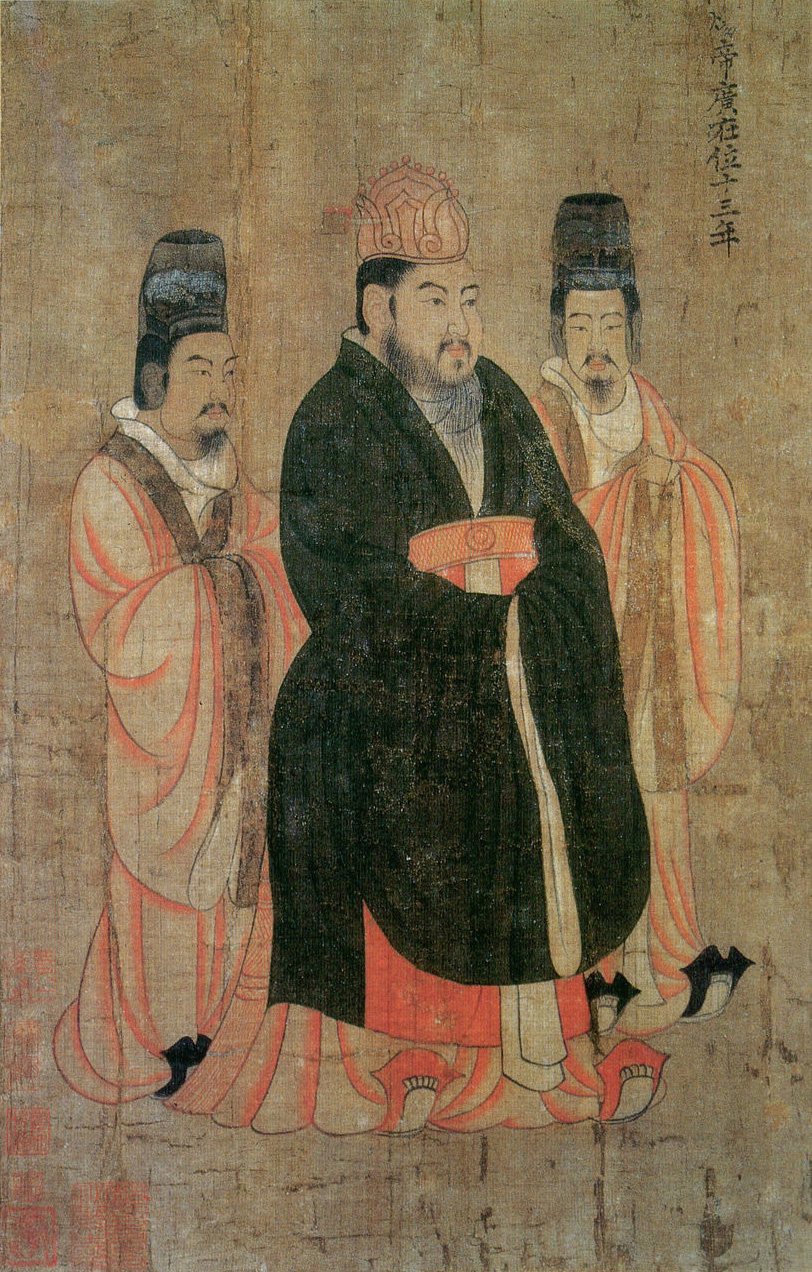
  7. Emperor Yang of SuiEmperor Yang of Sui in the Thirteen Emperors Scroll · A painting attributed to Yan Liben

    The Fall of Sui

    Sui drained its people’s strength with three expeditions against Goguryeo and huge projects such as the Grand Canal. From 611, commoners worn down by harsh forced labor for the war preparations began to rise up, and in 613 even the aristocrat Yang Xuangan rebelled. During the third expedition, in 614, the troops who had been summoned could not arrive in time. In 618, Emperor Yang was killed by his own officials at Jiangdu (today’s Yangzhou); the leader of that revolt, Yuwen Huaji, was the son of Yuwen Shu, the general defeated at the Salsu. That same year, Li Yuan founded the Tang dynasty.

    Samguk Sagi, Goguryeo Annals, King Yeongyang · Book of Sui

Key Words of This Episode

Next episode

Episode 35 · The Thousand-Li Wall

After Sui falls and Tang rises, Goguryeo tries to make peace with its new neighbor. But when Tang tears down the “gyeonggwan” victory mound from the Sui wars in 631, Goguryeo begins building a wall a thousand li long on its western frontier — and Yeon Gaesomun, the overseer who wears five swords, appears.

Photo credits

All illustrations in this webtoon are original. Character names and dialogue are imaginative reconstructions based on historical facts and research. Dates and interpretations follow mainstream scholarship; where scholars disagree, the History Notes say so.